The Group of Death is Dead
Brazil 2014. Group D. Uruguay, England, Italy, and Costa Rica. Three former World Cup winners sharing four spots in the group stage, only two of which would advance. I remember watching at home that summer, glued to the screen as Robin van Persie launched himself into a diving header against Spain in a different group, thinking the whole tournament felt electric. But Group D was the one everyone had circled before a ball was kicked.
And it delivered. Costa Rica, ranked 28th at the time, went undefeated to top the group. Italy and England, two of the sport’s most decorated programs, were sent home early, scraping together just 4 points between them. For Italy, the damage ran even deeper. Their 2-1 win over England in that group turned out to be the only World Cup match they’ve won since lifting the trophy in 2006. They haven’t even qualified for the tournament since, missing out in 2018, 2022, and again in 2026. A Group of Death doesn’t just end your tournament. Sometimes it marks the end of an era.
Here’s the thing, though. By the numbers, Group D wasn’t even the toughest group in that tournament. That belonged to Group G: Germany, Portugal, the United States, and Ghana, which had the lowest combined FIFA ranking at draw date. The group everyone felt was the Group of Death and the group the data says was the Group of Death were two different groups.
That disconnect sits at the heart of why the Group of Death is such a slippery concept. And it might not matter much longer, because the 2026 World Cup is about to kill it off entirely.
What Makes a Group of Death?
There’s no official definition. Ask five football writers which group was the Group of Death in any given tournament and you might get three different answers. Even the measurement is debatable.
Do you use the FIFA World Rankings or the World Football Elo Ratings? Do you take the rankings at the draw or at the start of the tournament? And do you measure all four teams or just the top three?
These choices matter. In that same 2014 tournament, Portugal was ranked 14th at the draw but had surged to 4th by kickoff. A swing like that completely changes how dangerous Group G looks depending on when you measure it. The FIFA ranking system itself has been overhauled multiple times. The formula used in the 1990s barely resembles the Elo-based system adopted in 2018.
For this chart, I used a simple, reproducible approach: FIFA rankings at the time of the draw, summing all four teams in each group. The lower the total, the tougher the group, at least on paper. I picked the lowest-scoring group from each tournament.
It’s a starting point. Not the final word.
The Chart
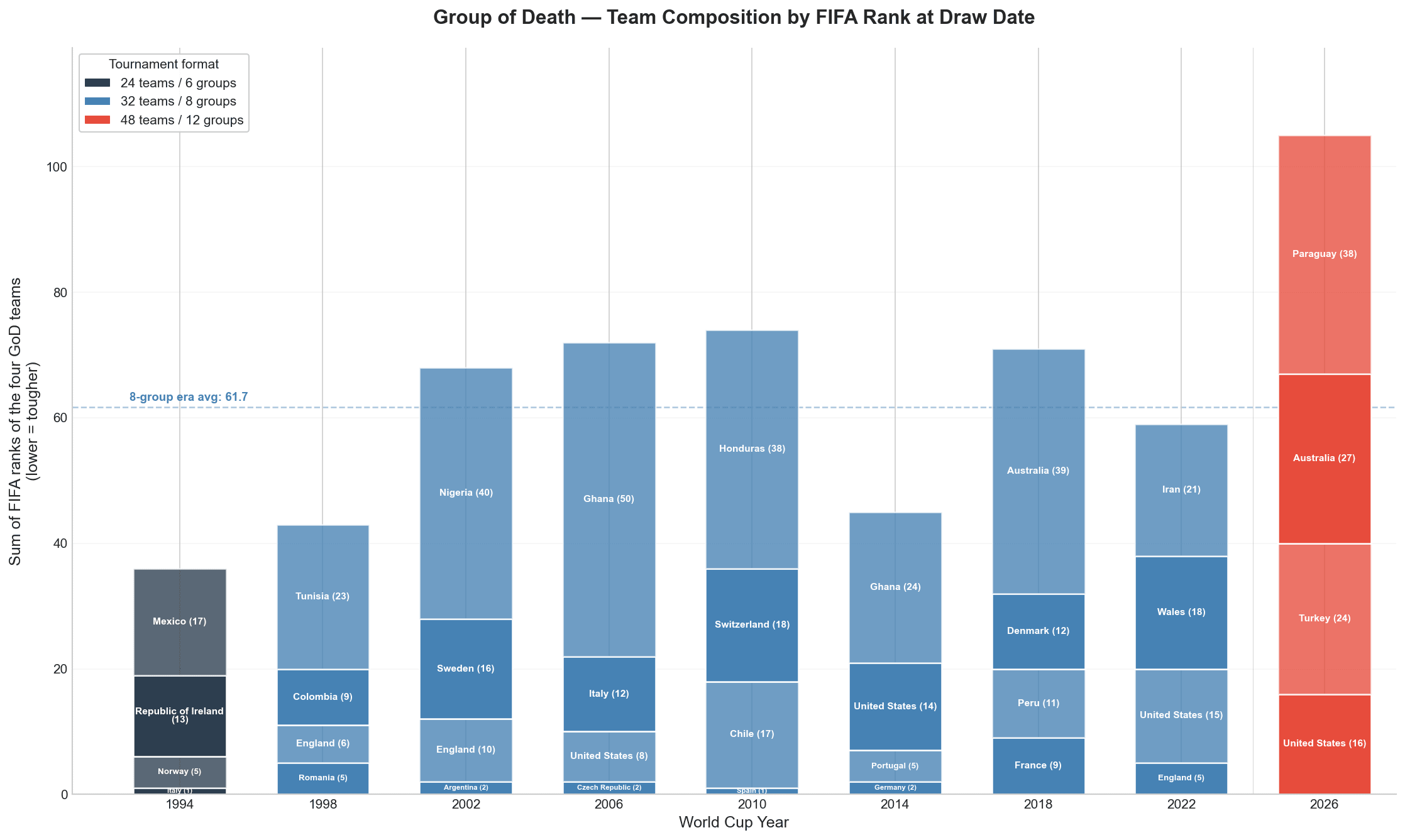
Each bar represents the group with the lowest combined FIFA ranking at draw date. Teams are stacked from highest-ranked at the bottom to lowest-ranked at the top.
In the 32-team era (1998 to 2022), the toughest group by this measure averaged a combined ranking of about 62. The 2026 equivalent lands at 105, nearly double the toughest groups of the past.
Some of these line up with what the media called the Group of Death at the time. The 2002 chart entry is Group F (Argentina, England, Sweden, Nigeria), which is universally recognized as one of the most brutal draws in World Cup history. Argentina, ranked 2nd in the world, didn’t make it out.
Others don’t line up at all. The 2018 consensus Group of Death was Group F, featuring defending champion Germany alongside Mexico, Sweden, and South Korea. Germany was stunned and eliminated in the group stage. My ranking-sum approach points to a different group entirely.
That gap between “lowest combined ranking” and “the group everyone was talking about” reveals something important. Raw rankings don’t capture everything. Pedigree, recent form, narrative weight, and the quality gap between the third and fourth seeds all play a role in what makes a group feel genuinely dangerous.
Why It Can’t Come Back
The math behind the 2026 format makes it straightforward. With 48 teams drawn from rank-separated pots across 12 groups of four, the ceiling on how stacked any single group can get is dramatically lower. You can’t end up with three top-10 teams in the same group. The pot structure prevents it.
And it gets worse. In eight of the twelve groups, three teams will advance to the knockout round. When you only need to beat one out of three opponents to survive, the stakes collapse. Teams can load-manage their way through the group stage, resting stars and treating it as a warmup rather than the pressure cooker it used to be.
The Group of Death worked because elimination was real. Two spots. Four teams. Someone good was going home. With the new format, that knife’s edge is gone.
What’s Next
The Group of Death gave the World Cup an extra layer of drama before the tournament even started. It punished complacency, rewarded depth, and produced some of the competition’s most memorable storylines. With the new format, that chapter is closing.
But before we bury it, it deserves a proper autopsy. The ranking-sum approach in this chart is a starting point, but it’s blunt. It doesn’t account for the gap between seeds, historical pedigree, or how different ranking systems tell different stories about the same group.
In the next post, we’ll build a metric that can do better. Then we’ll put it to work, not just on the Groups of Death, but on every group from every World Cup. All of them, ranked.